

 PDF
PDF  Views
Views  Share
Share


An Account of Acute Adverse Drug Reactions Occurring in a Day-Care Chemotherapy Unit of a Tertiary Care Cancer Hospital—A Prospective Observational Study
CC BY 4.0 · Indian J Med Paediatr Oncol 2026; 47(03): 197-202
DOI: DOI: 10.1055/s-0042-1756481
Abstract
Introduction Acute adverse drug reactions (ADRs) in day-care chemotherapy are not uncommon and are easily manageable on most occasions. However, sometimes they may lead to untoward events. It is paramount to document and analyze such events in contemporary medical oncology practice for the best utilization and planning of available personnel and resources.
Objective Our objective was to analyze the acute ADRs occurring in day-care cancer chemotherapy settings.
Materials and Methods ADRs reported in a day-care cancer chemotherapy setting, during the administration of chemotherapy, were prospectively observed and analyzed from 01 June 2020 to 31 December 2020. ADRs were classified into anaphylactic, allergic, and gastrointestinal (GI) (nausea/vomiting/heart burns/chest tightness). All ADRs were graded according to the Common Terminology Criteria for Adverse Events Version 5.0. Suspected drugs, time to reaction, and corrective measures were analyzed.
Results During the study period, a total of 10,120 sessions of day-care chemotherapy were administered. ADRs were noticed in 118 cases (1.18%). Among the reported ADRs, the mean and median age of the patients in this study was 52 years (21–88). Women outnumbered men (n = 81, 68.64% vs n = 37, 31.36%). Anaphylactic reactions (50.92%) were the most common followed by allergic (25.15%) and GI reactions (23.93%). No grade IV reaction was observed. Oxaliplatin-induced allergic reactions (n = 28, 23.73%) were noted most frequently. In majority of sessions (n = 93, 78.81%), the same chemotherapy regimen was readministered and completed uneventfully after the administration of antihypersensitivity medications.
Conclusion Serious ADRs are rare in current day-care chemotherapy administration. Most acute ADRs were of mild grade and successfully managed with antihypersensitivity medication.
Keywords
ADRs - chemotherapy sessions - type of reactions - severityPublication History
Article published online:
28 November 2022
© 2022. The Author(s). This is an open access article published by Thieme under the terms of the Creative Commons Attribution License, permitting unrestricted use, distribution, and reproduction so long as the original work is properly cited. (https://creativecommons.org/licenses/by/4.0/)
Thieme Medical and Scientific Publishers Pvt. Ltd.
A-12, 2nd Floor, Sector 2, Noida-201301 UP, India
We recommend
- An Analysis of Acute Adverse Drug Reactions Occurring in Day Care Chemotherapy Setting in a Tertiary Care Cancer CentreSenthil J. R., Indian J Radiol Imaging, 2021
- Chemotherapy-induced adverse drug reactions in oncology patients: A prospective observational surveyDeepti Chopra, Harmeet Singh Rehan, Vibha Sharma, et al., Indian Journal of Medical and Paediatric Oncology, 2016
- Pattern of Adverse Drug Reactions to Anticancer Drugs: A Quantitative and Qualitative AnalysisShruti Singh, Indian Journal of Medical and Paediatric Oncology, 2017
- A Study on Utilization and Evaluation of Antiemetics in Chemotherapy‑induced Nausea and VomitingGayathri Baburaj, TH Open, 2017
- Efficacy of Antiemetic Regimens for Prevention and Treatment of Chemotherapy-Induced Nausea and Vomiting in Patients of Breast Cancer Receiving Highly Emetogeni...Soumya Vij, Indian Journal of Medical and Paediatric Oncology, 2020
- Exploratory phase II trial of an anti-PD-1 antibody camrelizumab combined with a VEGFR-2 inhibitor apatinib and chemotherapy as a neoadjuvant therapy for triple...Xiaoxiao Liu, Signal Transduction and Targeted Therapy, 2025
- SHR-A1811 (antibody-drug conjugate) in advanced HER2-mutant non-small cell lung cancer: a multicenter, open-label, phase 1/2 study<svg viewBox="0 0 24 24" fill="none" xmlns="http://www.w3.org/2000/svg">
</svg> Ziming Li, Signal Transduction and Targeted Therapy, 2024 - Irinotecan with trifluridine/tipiracil and bevacizumab for second-line metastatic colorectal cancer: a phase II multicenter studyWenwei Yang, Signal Transduction and Targeted Therapy, 2026
- First-line camrelizumab (a PD-1 inhibitor) plus apatinib (an VEGFR-2 inhibitor) and chemotherapy for advanced gastric cancer (SPACE): a phase 1 studyXiaofeng Chen, Signal Transduction and Targeted Therapy, 2024
- Neoadjuvant apatinib addition to sintilimab and carboplatin-taxane based chemotherapy in patients with early triple-negative breast cancer: the phase 2 NeoSAC t...Guoshuang Shen, Signal Transduction and Targeted Therapy, 2025
Abstract
Introduction Acute adverse drug reactions (ADRs) in day-care chemotherapy are not uncommon and are easily manageable on most occasions. However, sometimes they may lead to untoward events. It is paramount to document and analyze such events in contemporary medical oncology practice for the best utilization and planning of available personnel and resources.
Objective Our objective was to analyze the acute ADRs occurring in day-care cancer chemotherapy settings.
Materials and Methods ADRs reported in a day-care cancer chemotherapy setting, during the administration of chemotherapy, were prospectively observed and analyzed from 01 June 2020 to 31 December 2020. ADRs were classified into anaphylactic, allergic, and gastrointestinal (GI) (nausea/vomiting/heart burns/chest tightness). All ADRs were graded according to the Common Terminology Criteria for Adverse Events Version 5.0. Suspected drugs, time to reaction, and corrective measures were analyzed.
Results During the study period, a total of 10,120 sessions of day-care chemotherapy were administered. ADRs were noticed in 118 cases (1.18%). Among the reported ADRs, the mean and median age of the patients in this study was 52 years (21–88). Women outnumbered men (n = 81, 68.64% vs n = 37, 31.36%). Anaphylactic reactions (50.92%) were the most common followed by allergic (25.15%) and GI reactions (23.93%). No grade IV reaction was observed. Oxaliplatin-induced allergic reactions (n = 28, 23.73%) were noted most frequently. In majority of sessions (n = 93, 78.81%), the same chemotherapy regimen was readministered and completed uneventfully after the administration of antihypersensitivity medications.
Conclusion Serious ADRs are rare in current day-care chemotherapy administration. Most acute ADRs were of mild grade and successfully managed with antihypersensitivity medication.
Keywords
ADRs - chemotherapy sessions - type of reactions - severity
Introduction
Adverse reactions to chemotherapy drugs occurring at various time intervals are well described.[1] Many current systemic treatment protocols include biological agents like monoclonal antibodies, immune checkpoint inhibitors in addition to the standard cytotoxic chemotherapy drugs either alone or in combinations. Despite administering the standard premedication, in reality acute adverse drug reactions (ADRs) do occur in the day-care chemotherapy setting. We report the incidence of all the allergic reactions in the day-care chemotherapy units of Basavatarakam Indo-American Cancer Hospital and Research Institute (BIACH-RI), Hyderabad, India
Our aim was to analyze the acute ADRs occurring in day-care cancer chemotherapy units in terms of causality and management.
Material and Methods
This was a prospective observational study carried out in the department of medical oncology at the day-care setting and a tertiary care teaching cancer hospital. All patients receiving chemotherapy in the day-care setting in the institute between 1st June 2020 and 31st December 2020 were included in the study in which 10,120 day-care chemotherapy sessions, that is, 3,360 patients were included. Each session of day-care chemotherapy was counted as one; hence, one patient could have received more than one session of chemotherapy. In each session of chemotherapy, patients were given the standard of care premedication, chemotherapy, and/or monoclonal antibody/immune checkpoint inhibitor as per the treatment protocol. All acute drug reactions were recorded and documented according to the Common Terminology Criteria for Adverse Events (CTCAE) version 5.0.[1] Reactions were classified into allergic, anaphylactic and gastrointestinal (GI) reactions.
A patient was identified to have an allergic reaction if he/she developed a disorder characterized by an adverse local or general response from exposure to a drug.[1]
Anaphylaxis is defined as a disorder characterized by an acute inflammatory reaction resulting from the release of histamine and histamine-like substances from mast cells, causing a hypersensitivity immune response, clinically, identified as breathing difficulty, dizziness, hypotension, cyanosis, and loss of consciousness.[1]
GI reactions were identified as any one of the symptoms including dysphagia, nausea and vomiting, heartburn, and regurgitations. Each of the adverse reactions was classified into five grades as per CTCAE version 5.0.[1]
The outcome measures of the study consisted of:
Primary outcome measures: frequency of ADR in day-care chemotherapy setting.
Secondary outcome measures: type of ADR and its grading, suspected drug, and outcomes of ADRs.
All patients aged 18 years and above undergoing day-care chemotherapy in the study period were included in the study irrespective of the number of cycles. Each day-care chemotherapy administration was called one “session.” The total number of chemotherapy sessions during the study period formed the denominator for analysis.
These ADRs were collected as per BIACH-RI protocol; hence, the data collection form mainly consisted of ([Fig. 1]):
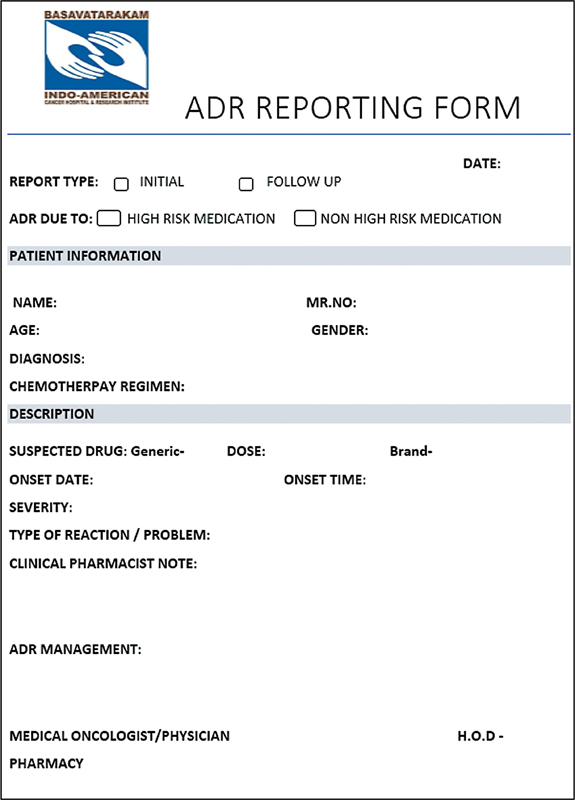
Fig 1: Data collection form
Demographic details of patients: name, age, gender, and hospital register number.
Diagnosis, chemotherapy regimen.
Type of ADR and its severity.
Suspected drug.
Corrective action.
Exclusion criteria: Patients receiving blood or blood products in the day-care setting were excluded from the analysis.
Statistical analysis: Reactions were tabulated and analyzed using simple statistical methods using the Microsoft excel program (mean–median range).
Ethics
This was an observational study, and there was no study-specific intervention. Institutional ethics committee approval was obtained from the institutional ethics committee BIACH-RI, Hyderabad Dt 16 June 2020(IEC/2020/08). Informed consent waiver showed obtained and was ([Fig. 2]). Authors certified that the study was performed in accordance with the ethical standards as laid down in the 1964 Declaration of Helsinki and its later amendments or comparable ethical standards.
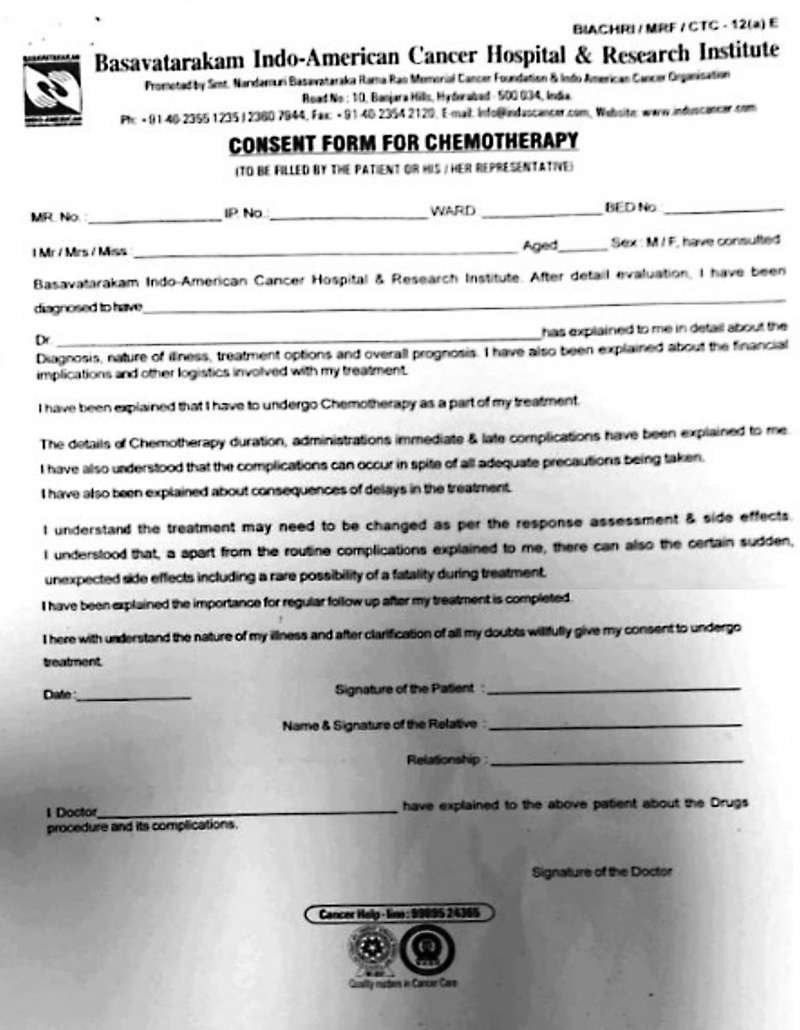
Fig 2: Consent form.
Results
A total of 10,120 daycare chemotherapy sessions, that is, 3,360 patients were included in the study.
Baseline characteristics are given in [Table 1].
|
Age (years) |
Mean median age 52 y (21–88) |
|
|---|---|---|
|
Gender |
Male number (%) Female number (%) |
N = 37, 31.36% N = 81, 68% |
|
Primary malignancy |
Breast Upper GI Colorectal Lymphoma Ovary Endometrium Cervix Pancreas Tongue Lung Other |
N = 24, 20.34% N = 23, 19.49% N = 19, 16.10% N = 18, 15.25% N = 15, 12.71% N = 4, 3.39% N = 4, 3.39% N = 3, 2.54% N = 3, 2.54% N = 2, 1.69% N = 3, 2.54% |
Type of reactions and its severity
|
Sl. no: |
Severity |
Anaphylactic reactions (%) |
Allergic reactions (%) |
GI- reactions (%) |
Total |
|---|---|---|---|---|---|
|
1 |
Grade 1 |
12 (07.36%) |
04 (02.45%) |
2 (01.23%) |
18 (11.04%) |
|
2 |
Grade 2 |
48 (29.45%) |
23 (14.11%) |
21 (12.88%) |
92 (56.44%) |
|
3 |
Grade 3 |
23 (14.11%) |
14 (08.59%) |
16 (09.82%) |
53 (32.52%) |
|
Total |
83 (50.92%) |
41 (25.15%) |
39 (23.93%) |
163 (100.00) |
Abbreviation: GI, gastrointestinal.
|
Sl. no |
Type of reaction |
Signs and symptoms |
No. of sessions |
Percentage |
|---|---|---|---|---|
|
1 |
Anaphylactic reactions |
Breathing difficulty |
33 |
16.67 |
|
2 |
Dizziness |
21 |
10.61 |
|
|
3 |
Hypotension |
2 |
1.01 |
|
|
4 |
Cyanosis |
8 |
4.04 |
|
|
5 |
Shivering with/without chills |
26 |
13.13 |
|
|
6 |
Fever |
4 |
2.02 |
|
|
7 |
Loss of consciousness |
3 |
1.52 |
|
|
8 |
GI reactions |
Chest tightness |
3 |
1.52 |
|
9 |
Nausea and vomiting |
14 |
7.07 |
|
|
10 |
Heart Burns |
8 |
4.04 |
|
|
11 |
Epigastric pain/stomach pain |
14 |
7.07 |
|
|
12 |
Loose stools |
1 |
0.51 |
|
|
13 |
Allergic reactions |
Rashes |
35 |
17.68 |
|
14 |
Mucositis |
0 |
0 |
|
|
15 |
Itching |
20 |
10.10 |
|
|
16 |
Peeling of skin/burning sensation |
6 |
3.03 |
|
|
Total |
198 |
100.00 |
|
Sl. no. |
Causative drug |
Number anaphylactic reactions (%) |
Allergic reactions (%) |
GI reactions (%) |
No. of sessions (%) |
||||||
|---|---|---|---|---|---|---|---|---|---|---|---|
|
Grade I |
II |
III |
Grade I |
II |
III |
Grade I |
II |
III |
|||
|
1 |
Oxaliplatin |
21 (25.30%) |
14(32.56%) |
6(15.38%) |
28 (23.73%) |
||||||
|
1 |
14 |
6 |
0 |
8 |
6 |
0 |
3 |
3 |
|||
|
2 |
Paclitaxel |
16 (19.28%) |
4(09.30%) |
6(15.38%) |
21(17.80%) |
||||||
|
1 |
11 |
4 |
1 |
1 |
2 |
0 |
4 |
2 |
|||
|
3 |
Carboplatin |
9 (10.84%) |
9(20.93%) |
3(07.69%) |
14(11.86%) |
||||||
|
0 |
9 |
0 |
1 |
7 |
1 |
0 |
1 |
2 |
|||
|
4 |
Rituximab |
9 (10.84%) |
4(09.30%) |
7(17.95%) |
13(11.02%) |
||||||
|
0 |
7 |
2 |
0 |
2 |
2 |
0 |
5 |
2 |
|||
|
5 |
Docetaxel |
7 (08.43%) |
3(06.98%) |
2(05.13%) |
9(07.63%) |
||||||
|
3 |
1 |
3 |
2 |
1 |
0 |
0 |
1 |
1 |
|||
|
6 |
Trastuzumab |
7 (08.43%) |
0(00.00) |
0(00.00) |
8(06.78%) |
||||||
|
6 |
1 |
0 |
0 |
0 |
0 |
0 |
0 |
0 |
|||
|
7 |
5-flurouracil |
3 (03.61%) |
1(02.33%) |
5(12.82%) |
6(5.08%) |
||||||
|
1 |
1 |
1 |
0 |
0 |
1 |
2 |
2 |
1 |
|||
|
8 |
Leucovorin |
0 (00.00%) |
2(04.65%) |
4(10.26%) |
6(05.08%) |
||||||
|
0 |
0 |
0 |
1 |
1 |
0 |
0 |
1 |
3 |
|||
|
9 |
Irinotecan |
1 (01.20%) |
0(00.00) |
3(07.69%) |
4(03.39%) |
||||||
|
0 |
1 |
0 |
0 |
0 |
0 |
0 |
2 |
1 |
|||
|
10 |
Fosaprepitant |
1 (01.20%) |
2(04.65%) |
1(2.56%) |
3(02.54%) |
||||||
|
0 |
0 |
1 |
0 |
1 |
1 |
0 |
1 |
0 |
|||
|
11 |
Others |
9 (10.84%) |
4(09.30%) |
2(05.13%) |
6(05.08%) |
||||||
|
0 |
3 |
6 |
1 |
2 |
1 |
0 |
1 |
1 |
|||
|
Total |
83 (100.00) |
43 (100.00) |
39(100.00) |
118 (100.00) |
|||||||
|
12 |
48 |
23 |
6 |
23 |
14 |
2 |
21 |
16 |
|||
Most of the reactions occurred within 30 minutes of starting the intravenous chemotherapy (n = 61, 51.6%). Lesser number of reactions occurred between 30 minutes and 2 hours (n = 29, 24.58%) and toward the end of the infusion (n = 28, 23.73%) as shown in [Table 5].
|
Sl. no |
Onset of time (minutes) |
No. of sessions |
Percentage |
|---|---|---|---|
|
1 |
Start of infusion (< 5> |
61 |
51.69 |
|
2 |
During of infusion (>30 min to 2 h) |
29 |
24.58 |
|
3 |
End of infusion (<5> |
9 |
7.63 |
|
4 |
After of infusion (before discharge) |
19 |
16.10 |
|
Total |
118 |
100.00 |
Discussion
Adverse reactions to chemotherapy drugs have been well studied and described in the literature including acute, subacute, and chronic toxicities of different classes of chemotherapy drugs.[2] Standard premedication is administered for every chemotherapy protocol. In spite of taking adequate precautions, acute drug reactions like allergic, anaphylactic reactions pose a challenge in day-care units. ADRs are most often seen in multichemotherapy regimens than single-drug regimens. A similar observation was made by Hartwig et al who reported that allergic, anaphylactic reactions along with hematological reactions are most often seen in multiagent chemotherapy regimens.[2] [3] In addition, nausea, vomiting, epigastric burning sensation, and regurgitations were commonly reported. We analyzed acute drug reactions occurring exclusively in the day-care setting. We grouped all the acute drug reactions into three groups: allergic reactions, anaphylactic reactions, and GI symptoms. To the best of our knowledge, this is the largest single-center study of exclusive day-care chemotherapy infusion-related systemic reactions.
The observed 118 reactions accounted for 1.18%, of all the day-care chemotherapy infusions in the study period. The incidence is low but all the reactions occurred even after giving all the prescribed premedication. There seems to be a higher incidence among women; similar observations were made in earlier studies.[4] [5] [6] [7] [8] [9] The reason for gender difference is not clearly understood. But it can be explained by the higher incidence of breast cancer seen in our study population, similar to other studies.[7] [10] [11] However, there have been several other reports with men experiencing more number of ADRs than women.[12] [13] [14] [15] [16]
Oxaliplatin-induced allergic reactions were noted most frequently in our study, whereas other studies showed cisplatin, 5-fluracil, taxanes-induced reactions to be more common;[10] [12] [13] [14] [16] [17] this could alert us to administer antihistaminics as additional premedication for oxaliplatin-containing regimens. The majority of our patients had grade I to II reactions which were easily managed, similar to the study conducted in northeast Indian states where the reactions are mostly seen in grade I and II which may be due to chemotherapy.[10] Among patients with grade III reactions, one patient who developed anaphylactic reaction required overnight observation in the hospital; no patient died due to reaction. However, a 61-year-old lady who was diagnosed to have carcinoma of the stomach on FLOT (5-fluracil + lecovorin + oxaliplatin + docetaxel) chemotherapy was noted to have recurrent allergic reactions to oxaliplatin inspite of administering additional premedications. This observation stresses that in a minority of patients management is likely to be challenging, and constant monitoring is important. Most of the drug reactions occurred within 2 hours from the start of infusion; this could be due to sequential administration of drugs, allergy-inducing drug being administered later in the line.
The reactions observed after the completion of infusion are mostly GI reactions, which could be easily managed with antacids or antiemetics.
Limitations of the Study
We included all day-care chemotherapy administrations in the study period and restricted this analysis only to acute drug reactions which are expected to occur on the day of administration. However, we did not precisely analyze the time gap between premedication and the actual administration of chemotherapy drug; the duration of infusion of each drug and extravasation reactions were also not included.
Benefits of the Study
Overall, our study presented the acute reactions encountered in the present-day medical oncology practice and highlighted the unexpected drugs to be associated with allergic reactions. Our analysis also stresses the importance of constant monitoring and appropriate use of human resources in the day-care units to monitor and manage the ADRs. All ADRs in the day-care setting should be strictly documented in the future to examine if there is a changing trend in the present-day practice that will be of practical importance to the country.
Conclusions
Acute allergic, anaphylactic, and GI reactions in the day-care chemotherapy setting are not uncommon and could be easily managed in most of the cases. Grade II and III reactions are most commonly observed, with oxaliplatin being the most frequent drug associated with ADR in the day-care setting. No grade IV reaction was encountered. Constant monitoring and prompt corrective action prevent serious adverse events.
Conflict of Interest
None declared.
Acknowledgment
We thank the almighty for giving strength and insight to carry out this work. We would like to thank all the patients and their families for their cooperation in collecting the data. We thank Dr. Pallavi Ladda, Dr. K. Sanata, and Dr. P. Nikhil along with postdoctoral medical oncology resident doctors for providing the information about ADRs during the study period. We thank the nursing staff and all the supportive staff for their cooperation. We thank the administration for all their support.
References
- Common Terminology Criteria for adverse events (CTCAE) version 5.0. U.S Department of Health and Human Services. November 27, 2017:2, 51, 24–43
- Khandelwal S. et al. Development of a predictor model for quality of life in cancer patients with adverse drug reactions due to cancer chemotherapy. J Appl Pharm Sci 2016; 6 (05) 022-028
- Hartwig SC, Siegel J, Schneider PJ. Preventability and severity assessment in reporting adverse drug reactions. Am J Hosp Pharm 1992; 49 (09) 2229-2232
- Singh S, Dhasmana DC, Bisht M, Singh PK. Patterns of adverse drug reactions to anti-cancer drugs: a quantitative and qualitative analysis. Indian J Med Paediatr Oncol 2017; 38 (02) 140-145
- Chopra D, Rehan HS, Sharma V, Mishra R. Chemotherapy-induced adverse drug reactions in oncology patients: a prospective observational survey. Indian J Med Paediatr Oncol 2016; 37 (01) 42-46
- Poddar S. et al. Pattern of adverse drug reactions due to cancer chemotherapy in tertiary care teaching hospital in Bangladesh. Dhaka Univ J Pharma Sci 2009; 8: 11-16
- Kirthi C. et al. A study on the adverse drug effects of anticancer drug in an oncology center IJPPS Han. 2014; 6: 580-583
- Thapaliya K. et al. Study of pattern of adverse drug reactions due to cancer chemotherapy & their management in hospitalized patients in BP Koirala Memorial Cancer Hospital. Journal of Chitwan Medical College 2014;4(10):
- Aghamohammadi H, Shrestha S, Kavousi S. Assessment of prescribing pattern of chemotherapy drugs and monitoring of adverse drug reaction in cancer patients. IJPSI 2019; 8 (01) 42-51
- Gunaseelan V. et al. adverse drug reactions to cancer chemotherapy in a regional cancer center in northeast India. IJPSR 2014; 5 (08) 3358-3363
- Saini VK, Sewal RK, Ahmad Y, Medhi B. Prospective observations study of adverse drug reactions of anti-cancer drugs used in cancer treatment in tertiary care hospital. Indian J Pharm Sci 2015; 77 (06) 687-693
- Wahlang JB, Laishram PD, Brahma DK, Sarkar C, Lahon J, Nongkynrih BS. Adverse drug reactions due to cancer chemotherapy in a tertiary care teaching hospital. Ther Adv Drug Saf 2017; 8 (02) 61-66
- Goyal NY. et al. Pattern of adverse drug reactions due to cancer chemotherapy in tertiary care teaching hospital in Gujarat. Int J Sci Res 2012; 3 (01) 333-335
- Mallik S, Palaian S, Ojha P, Mishra P. Pattern of adverse drug reactions due to cancer chemotherapy in a tertiary care teaching hospital in Nepal. Pak J Pharm Sci 2007; 20 (03) 214-218
- Prasad A, Datta PP, Bhattacharya J. et al. Pattern of adverse drug reactions due to cancer chemotherapy in tertiary care teaching hospital in Eastern India. J Pharmacovigil 2013; 1: 107
- Ramasubbu SK, Pasricha RK, Nath UK, Das B. Frequency, nature, severity and preventability of adverse drug reactions arising from cancer chemotherapy in a teaching hospital. J Family Med Prim Care 2020; 9 (07) 3349-3355
- Sharma A, Kumari KM, Manohar HD, Bairy KL, Thomas J. Pattern of adverse drug reactions due to cancer chemotherapy in a tertiary care hospital in South India. Perspect Clin Res 2015; 6 (02) 109-115
Address for correspondence
Publication History
Article published online:
28 November 2022
© 2022. The Author(s). This is an open access article published by Thieme under the terms of the Creative Commons Attribution License, permitting unrestricted use, distribution, and reproduction so long as the original work is properly cited. (https://creativecommons.org/licenses/by/4.0/)
Thieme Medical and Scientific Publishers Pvt. Ltd.
A-12, 2nd Floor, Sector 2, Noida-201301 UP, India
We recommend
- An Analysis of Acute Adverse Drug Reactions Occurring in Day Care Chemotherapy Setting in a Tertiary Care Cancer CentreSenthil J. R., Indian J Radiol Imaging, 2021
- Chemotherapy-induced adverse drug reactions in oncology patients: A prospective observational surveyDeepti Chopra, Harmeet Singh Rehan, Vibha Sharma, et al., Indian Journal of Medical and Paediatric Oncology, 2016
- Pattern of Adverse Drug Reactions to Anticancer Drugs: A Quantitative and Qualitative AnalysisShruti Singh, Indian Journal of Medical and Paediatric Oncology, 2017
- A Study on Utilization and Evaluation of Antiemetics in Chemotherapy‑induced Nausea and VomitingGayathri Baburaj, TH Open, 2017
- Efficacy of Antiemetic Regimens for Prevention and Treatment of Chemotherapy-Induced Nausea and Vomiting in Patients of Breast Cancer Receiving Highly Emetogeni...Soumya Vij, Indian Journal of Medical and Paediatric Oncology, 2020
- Pitfalls in ChemotherapyW. H. Palmer, The BMJ, 1939
- ABC of allergies: Adverse reactions to drugsD. Vervloët, Stephen K. Durham, The BMJ, 1998
- Comparison of starting antiemetic treatment 24 hours before or concurrently with cytotoxic chemotherapy.C. J. Williams, The BMJ, 1989
- Adverse drug reactions in elderly patients as contributing factor for hospital admission: cross sectional study<svg viewBox="0 0 24 24" fill="none" xmlns="http://www.w3.org/2000/svg">
</svg> Cyndie K. Mannesse, F. H. M. Derkx, Maria de Ridder, et al., The BMJ, 1997 - Behavioral Distress in Pediatric Patients With Cancer Receiving ChemotherapyMichael J. Dolgin, Pediatrics, 1989
Fig 1: Data collection form
Fig 2: Consent form.
References
- Common Terminology Criteria for adverse events (CTCAE) version 5.0. U.S Department of Health and Human Services. November 27, 2017:2, 51, 24–43
- Khandelwal S. et al. Development of a predictor model for quality of life in cancer patients with adverse drug reactions due to cancer chemotherapy. J Appl Pharm Sci 2016; 6 (05) 022-028
- Hartwig SC, Siegel J, Schneider PJ. Preventability and severity assessment in reporting adverse drug reactions. Am J Hosp Pharm 1992; 49 (09) 2229-2232
- Singh S, Dhasmana DC, Bisht M, Singh PK. Patterns of adverse drug reactions to anti-cancer drugs: a quantitative and qualitative analysis. Indian J Med Paediatr Oncol 2017; 38 (02) 140-145
- Chopra D, Rehan HS, Sharma V, Mishra R. Chemotherapy-induced adverse drug reactions in oncology patients: a prospective observational survey. Indian J Med Paediatr Oncol 2016; 37 (01) 42-46
- Poddar S. et al. Pattern of adverse drug reactions due to cancer chemotherapy in tertiary care teaching hospital in Bangladesh. Dhaka Univ J Pharma Sci 2009; 8: 11-16
- Kirthi C. et al. A study on the adverse drug effects of anticancer drug in an oncology center IJPPS Han. 2014; 6: 580-583
- Thapaliya K. et al. Study of pattern of adverse drug reactions due to cancer chemotherapy & their management in hospitalized patients in BP Koirala Memorial Cancer Hospital. Journal of Chitwan Medical College 2014;4(10):
- Aghamohammadi H, Shrestha S, Kavousi S. Assessment of prescribing pattern of chemotherapy drugs and monitoring of adverse drug reaction in cancer patients. IJPSI 2019; 8 (01) 42-51
- Gunaseelan V. et al. adverse drug reactions to cancer chemotherapy in a regional cancer center in northeast India. IJPSR 2014; 5 (08) 3358-3363
- Saini VK, Sewal RK, Ahmad Y, Medhi B. Prospective observations study of adverse drug reactions of anti-cancer drugs used in cancer treatment in tertiary care hospital. Indian J Pharm Sci 2015; 77 (06) 687-693
- Wahlang JB, Laishram PD, Brahma DK, Sarkar C, Lahon J, Nongkynrih BS. Adverse drug reactions due to cancer chemotherapy in a tertiary care teaching hospital. Ther Adv Drug Saf 2017; 8 (02) 61-66
- Goyal NY. et al. Pattern of adverse drug reactions due to cancer chemotherapy in tertiary care teaching hospital in Gujarat. Int J Sci Res 2012; 3 (01) 333-335
- Mallik S, Palaian S, Ojha P, Mishra P. Pattern of adverse drug reactions due to cancer chemotherapy in a tertiary care teaching hospital in Nepal. Pak J Pharm Sci 2007; 20 (03) 214-218
- Prasad A, Datta PP, Bhattacharya J. et al. Pattern of adverse drug reactions due to cancer chemotherapy in tertiary care teaching hospital in Eastern India. J Pharmacovigil 2013; 1: 107
- Ramasubbu SK, Pasricha RK, Nath UK, Das B. Frequency, nature, severity and preventability of adverse drug reactions arising from cancer chemotherapy in a teaching hospital. J Family Med Prim Care 2020; 9 (07) 3349-3355
- Sharma A, Kumari KM, Manohar HD, Bairy KL, Thomas J. Pattern of adverse drug reactions due to cancer chemotherapy in a tertiary care hospital in South India. Perspect Clin Res 2015; 6 (02) 109-115